

Buying a car is one of the biggest purchasing decisions most consumers make, but the factors that influence that decision are rarely the same from one customer to the next.
Two people might end up purchasing the same vehicle, yet arrive at that choice for completely different reasons. One may be attracted by the latest technology and driving experience, while another is focused on reliability, safety and value for money.
For automotive brands, manufacturers and dealerships, understanding these differences is becoming increasingly important. The challenge is that traditional customer data doesn’t always reveal what is really driving customer behaviour.
This is where segmentation becomes valuable. By identifying groups of customers with similar motivations, attitudes and decision-making processes, segmentation helps businesses move beyond broad assumptions and develop strategies that are more relevant, targeted and effective.
Looking beyond demographics
Automotive marketing has traditionally relied heavily on demographic information such as age, income, location and household composition. While these factors remain useful, they don’t always explain why customers choose one vehicle over another.
Two customers may look almost identical on paper, yet place value on entirely different things during the buying process. Segmentation helps uncover these underlying motivations, providing a richer understanding of what customers actually care about.
Consider two customers looking for a new SUV:
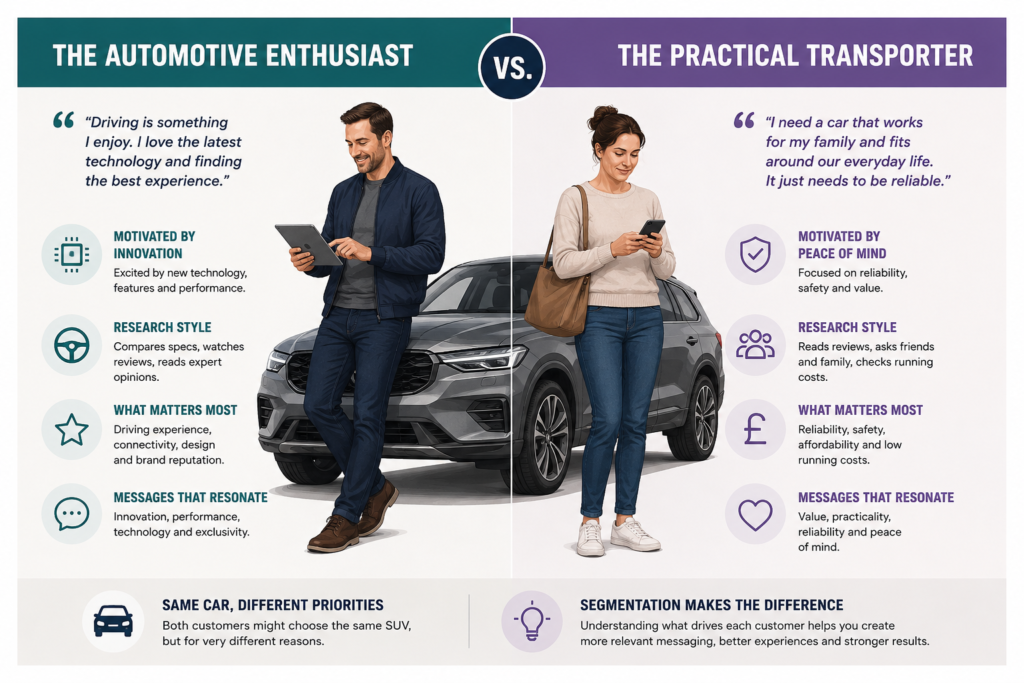
The Automotive Enthusiast
This customer enjoys researching vehicles, comparing specifications and exploring the latest technology. Features such as connectivity, innovation and driving experience often play an important role in their decision-making.
The Practical Transporter
This customer is less interested in the latest features and more concerned with reliability, safety, affordability and ease of ownership. Their focus is on finding a vehicle that fits seamlessly into everyday life.
Both customers could ultimately purchase the same vehicle, but the messaging, content and experiences that influence their decision may be completely different.
This example highlights why segmentation is so powerful; it allows businesses to understand not just what customers buy, but why they buy it.
Supporting product development and innovation
The value of segmentation extends far beyond marketing as understanding what different customer groups prioritise can help automotive businesses make better decisions about product development, service offerings and future investment.
While one audience may be attracted by advanced technology and premium features, another may place greater value on practical ownership benefits such as servicing packages, warranties or running costs.
These insights help organisations focus their efforts on the areas that matter most to their customers, improving both product-market fit and commercial performance.
Creating more effective customer journeys
The path to purchase in the automotive sector is rarely straightforward. Customers often move between websites, review platforms, social media, dealerships and recommendations from friends and family before making a decision.
And different segments follow different journeys; some customers immerse themselves in research and comparison, while others focus on reassurance, trust and ease of decision-making. Understanding these behaviours allows businesses to create customer journeys that feel more relevant and supportive at every stage.
The result is often stronger engagement, improved conversion rates and a better overall customer experience.
Building stronger customer relationships
For many automotive businesses, the relationship doesn’t end when the vehicle leaves the dealership. Servicing, maintenance, finance renewals and future purchases all create opportunities to strengthen customer loyalty.
Segmentation helps organisations understand what different customers value throughout the ownership journey, allowing them to personalise communications and create experiences that feel more relevant over time.
Rather than treating every customer the same, businesses can build longer-lasting relationships based on a genuine understanding of customer needs.
Turning customer understanding into competitive advantage
Automotive businesses have access to more customer data than ever before, but data alone doesn’t always explain behaviour. We believe that segmentation can bridge that gap by uncovering the motivations, attitudes and needs that sit behind customer decisions.
By understanding these differences, automotive brands can develop more effective marketing, make better product decisions and create customer experiences that resonate more strongly with the audiences they serve.